Janitorial company valuation: the account list, the owner's shifts and the deal terms
Teresa still cleaned two buildings every Friday. A buyer would have to pay someone to do that, and it changed her number more than anything else on the return.
By The YourBizWorth team · 8 min read
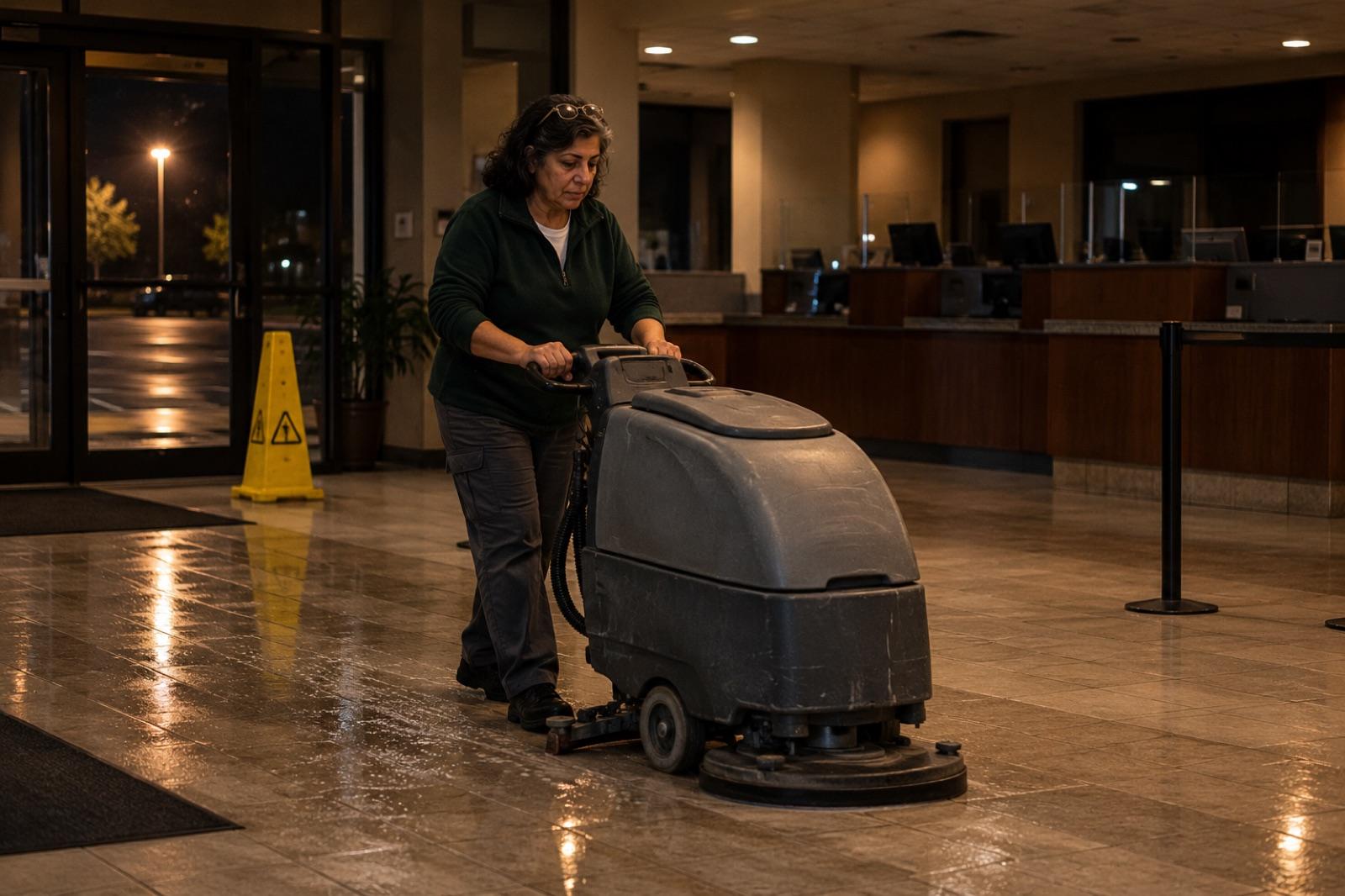
Janitorial company valuation was not on Teresa Haddad's mind on Friday nights. She was too busy running a floor scrubber through a bank lobby she had cleaned for four years.
Teresa is 61. She owns Haddad Building Care in Birch Falls: a crew of nine, two vans, and a list of offices, a medical practice, a car dealership and a church. She still cleans two buildings herself every Friday, and covers most sick calls.
She wanted a number she could defend before she talked to any buyer. This issue follows how she got it, account by account. Teresa, her company and Birch Falls are made up. The method is the one buyers and their lenders use.
Chapter 1
What a buyer is really buying
Teresa started by listing what she owned. Two vans with a lot of miles on them, four floor machines, a storage room of supplies. She added it up and laughed, because it was nowhere near what she hoped to sell for.
Then she understood why. Nobody buys a janitorial company for the mops. A buyer pays for the accounts: the checks that arrive every month, and the odds they keep arriving after Teresa leaves.
1.8x to 2.8xwhat cleaning businesses sold for, as a multiple of the owner's yearly earnings (SDE), in closed sales reported to BizBuySell
A janitorial company valuation comes down to three questions. What does the company earn for one owner? How many years of those earnings do buyers pay in this trade? And how sure can a buyer be that the accounts stay?
The third question is where two companies with the same earnings end up at different prices. It is answered by the account list, so that is where Teresa began.
If you want a rough range for your own company first, the free business value calculator takes your trade and two numbers from your return and gives you one in about a minute.
Chapter 2
The account list, read like a buyer reads it
Teresa wrote every client on one page: what they pay each month, whether there is a signed agreement, how much notice they have to give, and how long they have been with her.
Three things jumped off the page. The property manager alone was 28% of the billing. The church and the small offices, 34% of the billing, had nothing in writing at all.
And every signed agreement let the client leave on 30 or 60 days' notice. That is normal in janitorial work. It also means a buyer is really buying the relationship, not the paper.
Long tenure helps here. A church that has used the same company for twelve years is a good sign, even without a contract. But a buyer cannot show a handshake to a lender, so it counts for less than it should.
Some agreements also need the client's written consent before they pass to a new owner. An attorney should read each one before the company is listed.
Teresa's made-up account list. Together the accounts bill $34,000 a month, about $408,000 a year.
Account
Monthly billing
Paperwork
Years with Teresa
Property manager, three office buildings
$9,500
Signed, 30-day notice
9
Medical practice
$5,200
Signed, 60-day notice
6
Two bank branches
$4,300
Signed, 30-day notice
4
Car dealership
$3,600
Signed, 30-day notice
3
Church and its school hall
$2,800
Handshake
12
Eleven small offices
$8,600
Handshake
1 to 10
Worked example with made-up figures. A buyer will ask to read each signed agreement, not just this list.
Chapter 3
The Friday shift on the tax return
Next came the return. Last year's profit line said $52,000. Teresa added back her own pay and the costs a new owner would not carry, the way most small businesses are priced.
Then she stopped. Her own pay covered running the company, and also two buildings every Friday and most sick calls. A buyer who only wants to run the company would have to pay a cleaner for those hours.
2.0x, 3.0x, 4.1xmedian multiples of owner earnings that brokers reported for sales under $500,000, $500,000 to $1 million, and $1 million to $2 million (IBBA and M&A Source, Q4 2025)
At the 2.0x median brokers reported for small deals, the Friday shift moves the price from $222,000 to $186,000. That is $36,000 of value tied to hours only Teresa works.
Leaving it in does not make the money appear. A careful buyer or lender will take it out anyway, and the price will drop late in the deal, when it hurts most.
Teresa's made-up return, worked into owner earnings (SDE), with her own cleaning shifts taken back out.
Line
Amount
Why
Profit on the return
$52,000
The starting point
Teresa's own wages
+$40,000
A buyer who runs the company gets this pay
Depreciation on vans and machines
+$9,000
A tax deduction, not cash spent this year
Interest on the van loan
+$2,000
The buyer brings their own financing
Teresa's car and phone
+$5,000
Personal costs the company pays for
Floor machine rebuilt once
+$3,000
A one-time cost, not a yearly one
Owner earnings before her shifts
$111,000
What most owners stop at
Part-time cleaner for her shifts
-$18,000
A buyer has to pay someone to do them
Owner earnings a buyer will use
$93,000
The number to multiply
Worked example with made-up figures. Only add back what you can show on paper. The cost of covering the owner's shifts is an estimate a buyer will check against local wages.
The cleaning range
1.8x to 2.8x of $93,000 gives Teresa $167,000 to $260,000, from closed sales reported to BizBuySell.
The sales cross-check
0.5x to 0.9x of $408,000 in billing gives $204,000 to $367,000. It runs high because payroll takes most of what a janitorial company bills.
Why size matters
Brokers reported higher median multiples on larger deals. A bigger janitorial company with managers in place is a different purchase from a company where the owner still cleans.
Chapter 4
How the price gets paid
Teresa placed the company honestly. Long tenure and steady crews pulled it up. One account at 28% and a third of the billing on handshakes pulled it down. She settled near $186,000, in the lower half of the range.
Then she learned the price is only half the answer. How it gets paid matters just as much when the accounts can leave on 30 days' notice.
"I was charging myself nothing for Friday nights. A buyer would not get that deal, so the price could not include it."
Worth and what you take home are not the same number. A sale has costs: an attorney, taxes, and a broker fee or a listing fee. Plan with the price minus those costs, not the price alone.
Any purchase agreement, note or earnout should be written by your own attorney. We are not lawyers or brokers, and the terms of a real deal are yours to negotiate.
Seller financing
Part of the price paid to you over time. Morgan & Westfield, a brokerage, says seller notes are often 10% to 40% of the price and most sellers want at least half down.
Payments tied to accounts staying
When revenue depends on the owner, buyers may ask for an earnout tied to client retention, says one brokerage blog. Part of the price is paid only if the accounts stay.
A longer handoff
The same buyers may ask the seller to stay longer, introducing the new owner to each client. In a janitorial company, those introductions are much of what is being sold.
This monthHire a part-time cleaner for the Friday buildings, so the return already shows what a buyer will pay.
The next six monthsPut the church and the small offices on simple written agreements that a new owner can take over.
The next yearWin a few mid-size accounts so the property manager's share of the billing shrinks.
Before listingRun the numbers again on the newest return, with the account list and every agreement in one folder.
What to do instead
Write the account list firstEvery client on one page: monthly billing, signed or handshake, notice period, years with you. Then look for the biggest share and the handshakes, because a buyer will. Cleaning business value calculator
Take your own cleaning shifts out of the earningsAdd back your pay, then subtract what it costs to cover the shifts you clean yourself. Multiply what is left by the cleaning range from closed sales. Add-backs calculator
Expect the terms to follow the riskShort notice periods and one big account mean a buyer may ask for seller financing, an earnout or a longer handoff. Fixing the list before you sell narrows that ask. Start with the free calculator
Sources
BizBuySell, Business Valuation Multiples by IndustryBusinesses sold Q3 2021 through Q2 2026, updated biannually · Aggregated closed sales reported to BizBuySell over a trailing five-year periodFigures are averages of closed sales reported to one marketplace, US only. A marketplace sees the deals listed on it, not every sale in the country.
IBBA and M&A Source, Market Pulse Report, Q4 2025 (55th edition)Q4 2025, fielded January 1-15, 2026 · 350 brokers and advisors, 330 completed transactionsMedian SDE multiples by deal size: under $500K sells at 2.0x, $500K-$1M at 3.0x, $1M-$2M at 4.1x. Independent of marketplace data, which is why it is worth citing alongside.
Morgan & Westfield, Seller Financing (The Art of the Exit, chapter 3)Checked October 18, 2026 (page undated) · None. This is a brokerage firm describing market practice, not a dataset.States that seller notes average five years and vary from three to seven, that interest rates on them have ranged from 6% to 8%, and that notes are often 10% to 40% of the price. It says most small business sellers want at least 50% down. On defaults, it says a seller note should be secured with a UCC lien on the business assets and a personal guarantee, that a seller cannot take the business back without the buyer's permission or the dispute steps in the purchase agreement, and that in many instances a default is dealt with by talking with the buyer. It also claims businesses sold with seller financing bring 20% to 30% more than all-cash sales, with no dataset behind that figure. One firm's experience, not a survey.
IBA (business brokerage), The Owner Dependency Problem: What It Costs You When Selling a BusinessPublished June 10, 2026 (guest author Lawrence Lerner), checked October 18, 2026 · None. A brokerage blog describing how buyers behave, not a dataset.States that buyers treat revenue that depends on the owner as at risk and may apply a lower multiple to it, require earnouts tied to client retention, ask for an extended transition period, or move on to a less risky deal. Says three years is the standard guidance for reducing owner dependence and one year is enough for some improvements. Gives no discount figures, and none are used on this site.
YourBizWorth is not a broker, appraiser, or law firm. This column is general information, not legal, tax, or lending advice.
Questions people ask
How do you value a janitorial company?
Find the owner's earnings (SDE) from the tax return, subtract the cost of any shifts the owner cleans, and multiply by the range buyers paid for cleaning businesses: about 1.8 to 2.8 times, per BizBuySell's closed sales. The account list decides where you land.
Are handshake accounts worth less than signed contracts?
Usually, yes, even when the client has been loyal for years. A buyer and a lender can read a signed agreement, but not a handshake. Putting long-standing clients on simple written agreements before you sell is one of the cheapest fixes there is.
Do I count the cleaning I do myself?
Yes, as a cost. Add back your own pay, then subtract what a buyer would pay someone to cover your shifts and sick calls. A buyer will make that adjustment anyway, so it is better to show it first.
Why do bigger janitorial companies sell for higher multiples?
Brokers reported median multiples of 2.0 times owner earnings for sales under $500,000 and 3.0 times for $500,000 to $1 million (IBBA and M&A Source, Q4 2025). Larger companies often have managers, many accounts and less dependence on one owner.