Commercial cleaning business valuation: how buyers price a janitorial company
Carla thought her cleaning company was worth a year of sales. A buyer would look at her contracts, her crews and one big account first. Here is the math she did instead.
By The YourBizWorth team · 8 min read
Commercial cleaning business valuation sounds like a job for an expert. Carla Mendes found out it starts with papers she already had in a drawer.
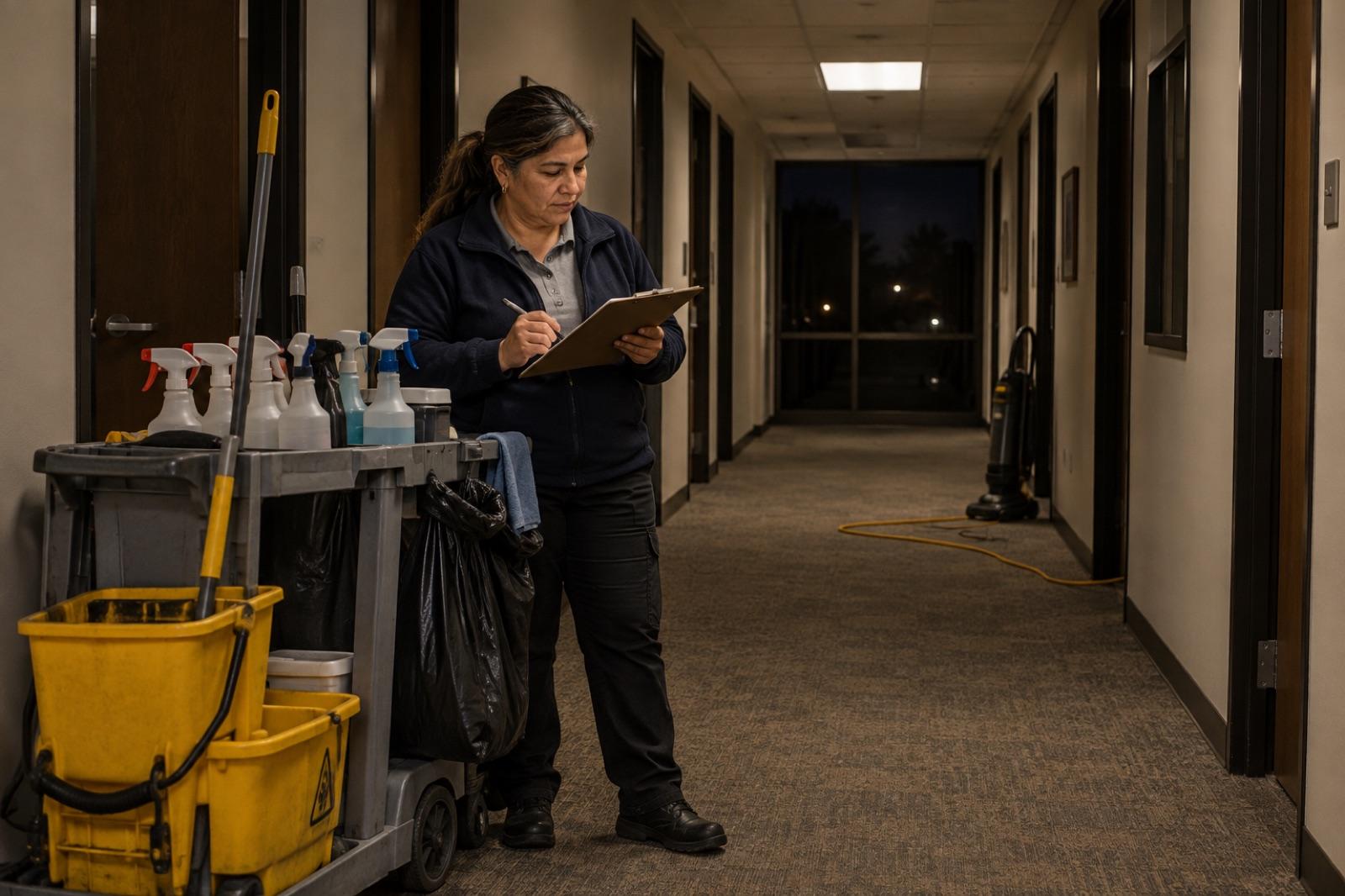
Carla is 52. She runs Mendes Building Services in Kettle Ridge: night crews that clean offices, a dental group and a small medical building. Fourteen people on payroll, three vans, and a phone that rings at 2 a.m. when an alarm trips.
She wanted to know what the company would sell for, and why. This issue follows how she worked it out. Carla, her supervisor Nadine, the company and Kettle Ridge are made up. The method is the one buyers and their lenders use.
Chapter 1
The number on the napkin
Example only, with made-up numbers. A supply rep told Carla that cleaning companies sell for about a year of sales. Mendes Building Services billed $640,000 last year, so the napkin said $640,000.
It felt good for about a day. Then Carla remembered how much of that money went straight back out the door as payroll, supplies and van payments.
1.8x to 2.8xwhat cleaning businesses sold for, as a multiple of the owner's yearly earnings (SDE), in closed sales reported to BizBuySell
A commercial cleaning company is priced on what it pays its owner, not on what it bills. Sales are a rough cross-check at best, because a janitorial company runs on payroll and its margins are thin.
So the first job is finding the owner's real earnings. The second is choosing a multiple from closed sales. The third, and the one most owners skip, is placing the company honestly inside the range.
If you want a rough range for your own company before reading on, the free business value calculator takes your trade and two numbers and gives you one in about a minute.
Chapter 2
From the tax return to owner earnings
Carla pulled three years of returns. Last year's profit line said $61,000. That is the number most owners stop at, and it is too low.
A return is built to lower taxes. Some costs on it are really Carla's pay, or her personal costs, or bills the company paid once and will not pay again.
This number is called seller's discretionary earnings, or SDE. It is what one owner who runs the company full time would take home. Most small cleaning companies are priced as a multiple of it.
One trap is specific to cleaning. If you also clean a shift yourself, a buyer will need to pay someone to cover it. Count that wage as a cost, not an add-back, or the buyer will do it for you.
Carla's made-up cleaning company, last year's return, worked into owner earnings (SDE).
Line
Amount
Why it is added back
Profit on the return
$61,000
The starting point
Carla's own wages
$55,000
A buyer who runs the company gets this pay
Depreciation on vans and floor machines
$14,000
A tax deduction, not cash spent this year
Interest on the van loan
$4,000
The buyer brings their own financing
Carla's personal vehicle and phone
$6,000
Personal costs the company pays for
Lawyer for a one-time lease dispute
$5,000
A one-time cost, not a yearly one
Owner earnings (SDE)
$145,000
$84,000 more than the profit line
Worked example with made-up figures. Only add back what you can show on paper. Crew wages, supplies and insurance stay as costs, because a buyer pays them too.
Chapter 3
The range, and the four things buyers check
With $145,000 in owner earnings, Carla ran the closed-sale multiples. She also ran the revenue check her supply rep had in mind, to see how far apart the two were.
The sales check came out higher than the earnings range. That happens when a company bills a lot and keeps a thin slice. A buyer's lender backs what the earnings can repay, so the earnings range is the one to trust.
Where a commercial cleaning company lands inside the range comes down to four things a buyer will ask to see.
Three ways to read Carla's made-up $145,000 in owner earnings and $640,000 in sales.
Yardstick
Multiple
What it gives Carla
Cleaning businesses, closed sales
1.8x to 2.8x SDE
$261,000 to $406,000
All deals under $500,000, median
2.0x SDE
$290,000
Cross-check on sales
0.5x to 0.9x revenue
$320,000 to $576,000
Sources: BizBuySell industry multiples (closed sales), IBBA and M&A Source Market Pulse Q4 2025. Worked example, not a valuation.
The contracts
Written agreements with a start date, a monthly value and renewal terms. Many let the client cancel on short notice, and some need the client's consent before they pass to a new owner. Read each one.
The biggest account
A buyer looks at how much of the billing one client brings in. If one account leaves and takes a large share with it, the price reflects that risk.
The crews
A supervisor who runs the nights, steady staff, written checklists and a supply routine. If the owner bids, schedules and covers every sick call, the buyer is buying a job.
The paperwork
Returns that match the books, payroll records, and proof of insurance and bonding. Commercial clients often require coverage, so buyers ask about it early.
Chapter 4
Where Carla landed, and what she changed
Carla was honest with herself. Her contracts renewed year after year, and Nadine ran most nights without a call. But one property manager with four office buildings was about 35% of the billing.
That put the company in the lower half of the range for now, somewhere near $290,000. It was less than half the napkin number. It was also a number she could defend to a buyer, line by line.
So she made a plan. Put the handshake accounts on paper. Win a few more mid-size offices so the big account shrinks as a share. Make Nadine's role official, with a raise and a title.
"I thought the company was worth what it billed. It is worth what it earns, and how sure a buyer can be that it keeps earning it."
155 daysmedian time on market for service businesses in Q2 2026 (BizBuySell, via Small Business Trends)
Worth and what you take home are not the same number. A sale has costs: an attorney, taxes, and a broker fee or a listing fee. Plan with the price minus those costs, not the price alone.
One eveningThree years of returns, the profit line, and every add-back written down with the line it came from.
The next weekA one-page contract list: client, start date, monthly value, notice period, and whether it can be assigned to a new owner.
The next yearShrink the biggest account's share, get handshake deals signed, and let the supervisor run the nights.
Before listingRun the numbers again on the newest return, and expect the sale itself to take months, not weeks.
What to do instead
Price on earnings, not billingStart from the profit line, then add back your own pay, depreciation, interest, personal costs and one-time costs. Crew wages stay as costs. Add-backs calculator
Use closed sales for cleaningMultiply owner earnings by 1.8 and by 2.8. Treat a revenue multiple as a cross-check only, because janitorial margins are thin. Start with the free calculator
Make the contracts, the accounts and the crews easy to checkA contract list with notice periods, no single account carrying the company, and a supervisor who runs the nights move you up the range. See how a listing is run
Sources
BizBuySell, Business Valuation Multiples by IndustryBusinesses sold Q3 2021 through Q2 2026, updated biannually · Aggregated closed sales reported to BizBuySell over a trailing five-year periodFigures are averages of closed sales reported to one marketplace, US only. A marketplace sees the deals listed on it, not every sale in the country.
IBBA and M&A Source, Market Pulse Report, Q4 2025 (55th edition)Q4 2025, fielded January 1-15, 2026 · 350 brokers and advisors, 330 completed transactionsMedian SDE multiples by deal size: under $500K sells at 2.0x, $500K-$1M at 3.0x, $1M-$2M at 4.1x. Independent of marketplace data, which is why it is worth citing alongside.
Small Business Trends, Small Business Acquisitions Drop 10% as Buyers Get More SelectivePublished August 11, 2026, reporting BizBuySell's Q2 2026 Insight Report; checked October 18, 2026 · BizBuySell survey of owners, buyers and brokers; sample size not stated in the articleReports that 35% of owners do not know what their business is worth and only 14% have completed a professional valuation. Also reports median time on market of 155 days for service businesses and 247 days for manufacturing in Q2 2026. A news summary of BizBuySell's figures, not the report itself.
YourBizWorth is not a broker, appraiser, or law firm. This column is general information, not legal, tax, or lending advice.
Questions people ask
What multiple does a commercial cleaning business sell for?
BizBuySell's closed sales put cleaning businesses at about 1.8 to 2.8 times owner earnings (SDE). Commercial companies with written, recurring contracts and crews that run without the owner tend to sit higher in that range.
Is a janitorial company worth a year of revenue?
Rarely. Closed sales put cleaning businesses at about 0.5 to 0.9 times a year of revenue. Because payroll eats most of what a janitorial company bills, buyers price on earnings and use revenue only as a cross-check.
Do my cleaning contracts transfer to the buyer?
It depends on each contract. Some can be assigned freely, some need the client's written consent, and many can be cancelled on short notice anyway. Have your attorney read them before you list, and tell buyers plainly what each one says.
What if one client is a large share of my billing?
Expect a buyer to see it as risk and price it in, or ask for terms tied to that client staying. The fix takes time: sign the account to a longer agreement and add other clients so its share shrinks.