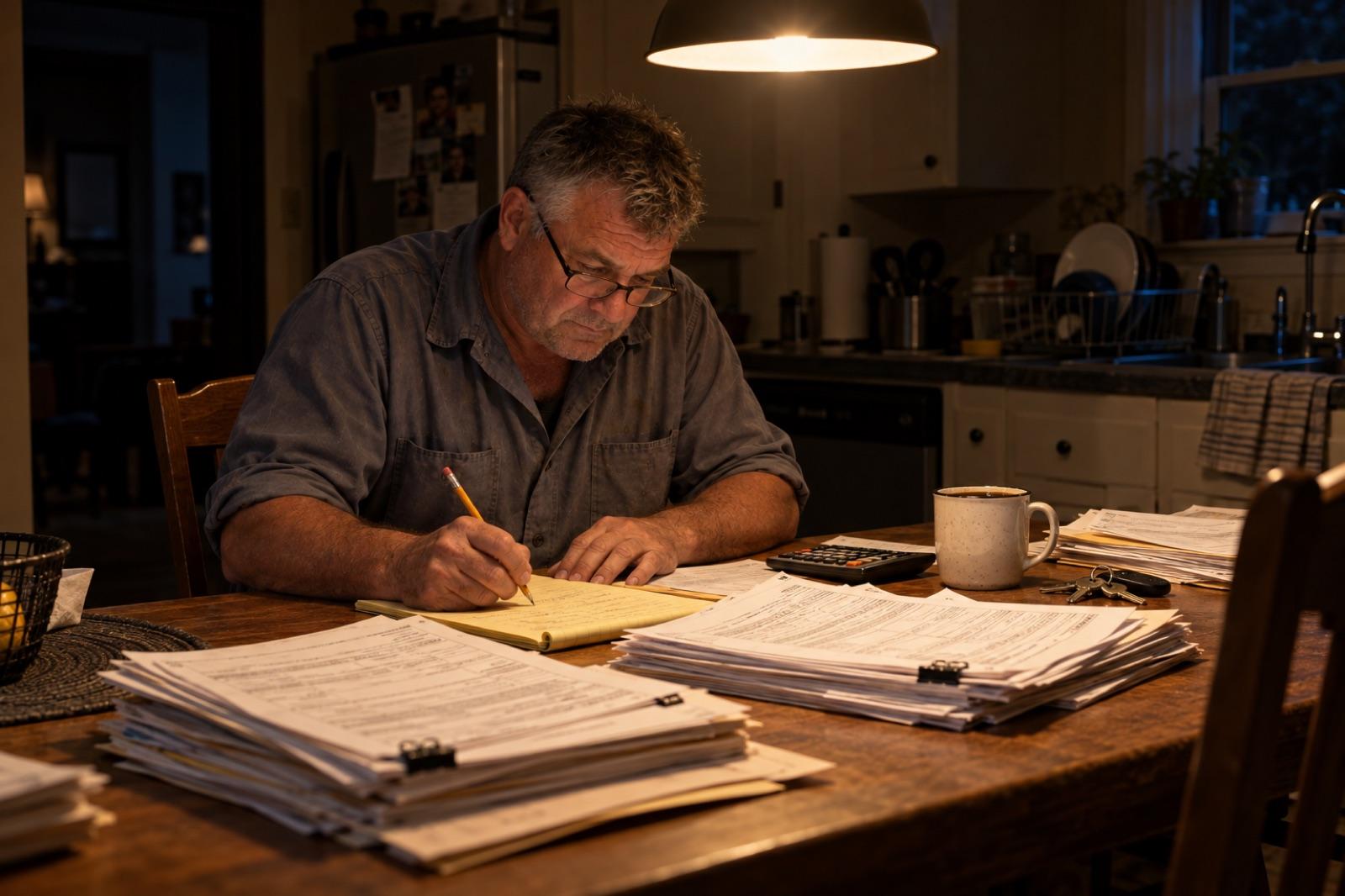
Dale had three answers to how much is my business worth, and none of them came from his own books. Here is how he found the real one in an evening.
By The YourBizWorth team · 8 min read
How much is my business worth? Dale Whitaker asked himself that on a Tuesday night in his shop office, with the bay doors down and the radio still on.
Dale is 58. He has run Whitaker Auto, a three-bay repair shop in Pine Hollow, for twenty-two years. One technician named Curtis, a part-time bookkeeper, and a lot full of cars every morning.
He had three answers, and all three came from someone else. This issue walks through how he swapped them for one he could defend. Dale, Curtis, the shop and Pine Hollow are made up. The method is the one buyers use.
Chapter 1
Three numbers, none of them his
Example only, with made-up numbers. At the diner, a friend told Dale a shop sells for a year of sales. Whitaker Auto took in about $540,000 last year, so that made it worth $540,000.
Dale's own number was $600,000, because that is what he figured he needed to retire. The third came from a website: a shop one county over was asking $450,000.
35%of owners do not know what their business is worth, and only 14% have had a professional valuation (BizBuySell, Q2 2026, via Small Business Trends)
All three guesses skip the one number a buyer checks first: what the business pays its owner each year. The answer starts there, on the tax return.
If you want a rough first range before reading on, the free business value calculator takes your trade and two numbers and gives you one in about a minute.
A year of sales
Sales are not what a buyer takes home. Two shops with the same sales can earn very different amounts, so a buyer looks past the top line.
What I need to retire
A real need, but a buyer cannot see it in the books. A buyer pays for what the business earns, not what the owner needs next.
What a similar shop is asking
An asking price is what a seller hopes for. Nobody knows what that shop will actually sell for, or whether it will sell at all.
Chapter 2
The number buyers actually price on
Dale took three years of returns home and spread them on the kitchen table. The profit line on last year's return said $46,000. For a moment he thought that was the whole story.
It was not. A tax return is built to lower your taxes. Plenty of money the shop spends on Dale, or spent once and will not spend again, shows up as a cost.
Accountants call this seller's discretionary earnings, or SDE. It is the profit, plus the owner's own pay, plus costs that a new owner would not carry. Most small businesses are priced as a multiple of it.
Dale did the same math for the two years before. The numbers were close, a little lower each year back. A steady or rising trend is what a buyer hopes to see.
Dale's made-up shop, last year's return, worked into owner earnings (SDE).
Line
Amount
Why it is added back
Profit on the return
$46,000
The starting point
Dale's own wages
$48,000
A buyer who runs the shop gets this pay
Depreciation
$11,000
A tax deduction, not cash spent this year
Interest on the lift loan
$3,000
The buyer brings their own financing
Dale's truck and phone
$5,000
Personal costs the shop pays for
Lift motor replaced once
$3,000
A one-time cost, not a yearly one
Owner earnings (SDE)
$116,000
$70,000 more than the profit line
Worked example with made-up figures. Only add back what you can show on paper. A buyer's lender will check every line against the returns.
Chapter 3
The multiple, and what moves it
With $116,000 in owner earnings, Dale needed one more number: how many years of earnings buyers pay for a shop like his. He found that closed sales answer it better than asking prices do.
2.0xthe median multiple of owner earnings (SDE) that brokers reported for sales under $500,000 (IBBA and M&A Source, Q4 2025)
The range is wide on purpose. Where a business lands inside it depends on things a buyer can see on a visit.
Three ways to read Dale's made-up $116,000 in owner earnings.
Yardstick
Multiple
What it gives Dale
Auto repair, closed sales
1.9x to 3.1x SDE
$220,000 to $360,000
All deals under $500,000, median
2.0x SDE
$232,000
All industries, average
2.7x cash flow
About $313,000
Cross-check on sales
0.4x to 0.75x revenue
$216,000 to $405,000
Sources: BizBuySell industry multiples (closed sales), IBBA and M&A Source Market Pulse Q4 2025, BizBuySell Q1 2026 Insight Report. Worked example, not a valuation.
Pushes it up
Customers who come back every year, a technician who stays after the sale, a lease with years left on it, and books that match the returns.
Pulls it down
An owner who does every diagnosis himself, one fleet account that brings in a big share of the work, a lease about to end, and messy records.
What it is not
A promise. A range is where similar sales landed. The price is what one buyer agrees to pay after looking closely.
Chapter 4
Where Dale landed
Dale was honest with himself. His customers came back, and the lot was full most mornings. But he still did nearly every hard diagnosis. Curtis did the brakes and the tires, and called Dale for the rest.
That put the shop in the lower half of the auto repair range, somewhere near $232,000. It was well under all three of his guesses. It was also the first number he could explain line by line.
So Dale made a plan for the next year. Curtis would take a diagnostics course, and Dale would hand him the hard jobs first. He would sell once the shop could run a week without him.
"I had three numbers and none of them were mine. Now I have one, and I can show a buyer where every dollar of it comes from."
Worth and what you take home are not the same number. A sale has costs: an attorney, taxes, and a broker fee or a listing fee. Plan with the price minus those costs, not the price alone.
One eveningThree years of returns, the profit line, and every add-back written down with the line it came from.
The same nightThe trade's multiple range from closed sales, and an honest look at where the business sits in it.
The next yearFix what pulls the number down: train the next person, renew the lease, clean up the books.
Before listingRun the numbers again on the newest return, so the price matches what a buyer will check.
What to do instead
Start from the tax return, not a rule of thumbFind the profit line, then add back your own pay, depreciation, interest, personal costs and one-time costs. Write down where each one comes from. Start with the free calculator
Use closed sales for your tradeMultiply owner earnings by the range buyers actually paid in your industry. Asking prices tell you what sellers hope for, not what buyers pay. How to value a small business
Place yourself honestly, then fix what pulls it downRepeat customers, staff who stay and a long lease push you up. An owner who does everything pulls you down, and a year of work can change that. See how a listing is run
Sources
Small Business Trends, Small Business Acquisitions Drop 10% as Buyers Get More SelectivePublished August 11, 2026, reporting BizBuySell's Q2 2026 Insight Report; checked October 18, 2026 · BizBuySell survey of owners, buyers and brokers; sample size not stated in the articleReports that 35% of owners do not know what their business is worth and only 14% have completed a professional valuation. Also reports median time on market of 155 days for service businesses and 247 days for manufacturing in Q2 2026. A news summary of BizBuySell's figures, not the report itself.
BizBuySell, Business Valuation Multiples by IndustryBusinesses sold Q3 2021 through Q2 2026, updated biannually · Aggregated closed sales reported to BizBuySell over a trailing five-year periodFigures are averages of closed sales reported to one marketplace, US only. A marketplace sees the deals listed on it, not every sale in the country.
IBBA and M&A Source, Market Pulse Report, Q4 2025 (55th edition)Q4 2025, fielded January 1-15, 2026 · 350 brokers and advisors, 330 completed transactionsMedian SDE multiples by deal size: under $500K sells at 2.0x, $500K-$1M at 3.0x, $1M-$2M at 4.1x. Independent of marketplace data, which is why it is worth citing alongside.
BizBuySell, Q1 2026 Insight ReportQ1 2026 · 2,345 closed transactions, $2B enterprise valueMedian sale price $350,000 on median cash flow of $165,256. Average cash flow multiple 2.7x across all industries.
YourBizWorth is not a broker, appraiser, or law firm. This column is general information, not legal, tax, or lending advice.
Questions people ask
Is there a quick rule of thumb for what my business is worth?
The closest thing is about 2 times owner earnings. IBBA and M&A Source reported a median of 2.0 times SDE on sales under $500,000 at the end of 2025. Your trade, your books and how much the business depends on you move it up or down.
Is my business worth a year of sales?
Usually not. Buyers price on what the business earns its owner, not on sales. For auto repair shops, BizBuySell's closed sales put prices at about 0.4 to 0.75 times a year of revenue, which is a rough cross-check at best.
Do I need to pay for a professional valuation?
For a sale between a willing buyer and seller, often not. The price is what the documented earnings support. Some situations call for a formal appraisal, like certain SBA loans, estates, divorces and partner disputes. Ask your lender or attorney.
How often should I work out what my business is worth?
Once a year, when the new tax return is filed, is a good habit. It takes an evening once you have done it the first time. It also tells you whether the changes you made are moving the number.